

This article written by Froebelian educator Eunjeong Ahn explores the importance of lived, embodied experience in the age of artificial experience.
In the age of artificial intelligence, information is no longer scarce. Children can access answers instantly, often without effort. Yet as information becomes easier to obtain, something equally essential is quietly diminishing: lived, embodied experience.
Human understanding does not begin with information. It begins with the body.
When a child encounters rain, the experience is not simply “it is raining.” The child feels water on the skin, observes the darkening sky, and senses changes in the air. These are not abstract facts but sensory encounters. Through repeated experiences, children begin to recognise patterns and infer causal relationships. In this way, experience becomes the foundation of thought.
Knowledge rooted in experience is not merely remembered; it is internalised, connected, and available for future thinking.
Over twenty-three years of teaching with Friedrich Froebel’s Gifts in Korea, I have witnessed this process unfold countless times. A moment comes to mind. I placed three rhombuses together on a table and asked a group of children what they could see. One child replied, “A hexagon.” Another tilted her head and said, “It’s a cube.”
The shapes were identical, but the acts of perception were different. The child who saw a cube was not guessing; she was drawing on accumulated experience - building, rotating, and manipulating three-dimensional forms. Her hands had taught her eyes to perceive depth where a flat surface appeared.
This may be understood as the essence of Friedrich Froebel’s educational philosophy. Children do not learn through passive reception of information, but through self-activity—direct engagement with form, space, and relationship.
His Gifts are not merely materials for play. They constitute a structured language through which children explore symmetry, transformation, and order. These ideas do not appear as abstractions but emerge through manipulation, variation, and reconstruction.
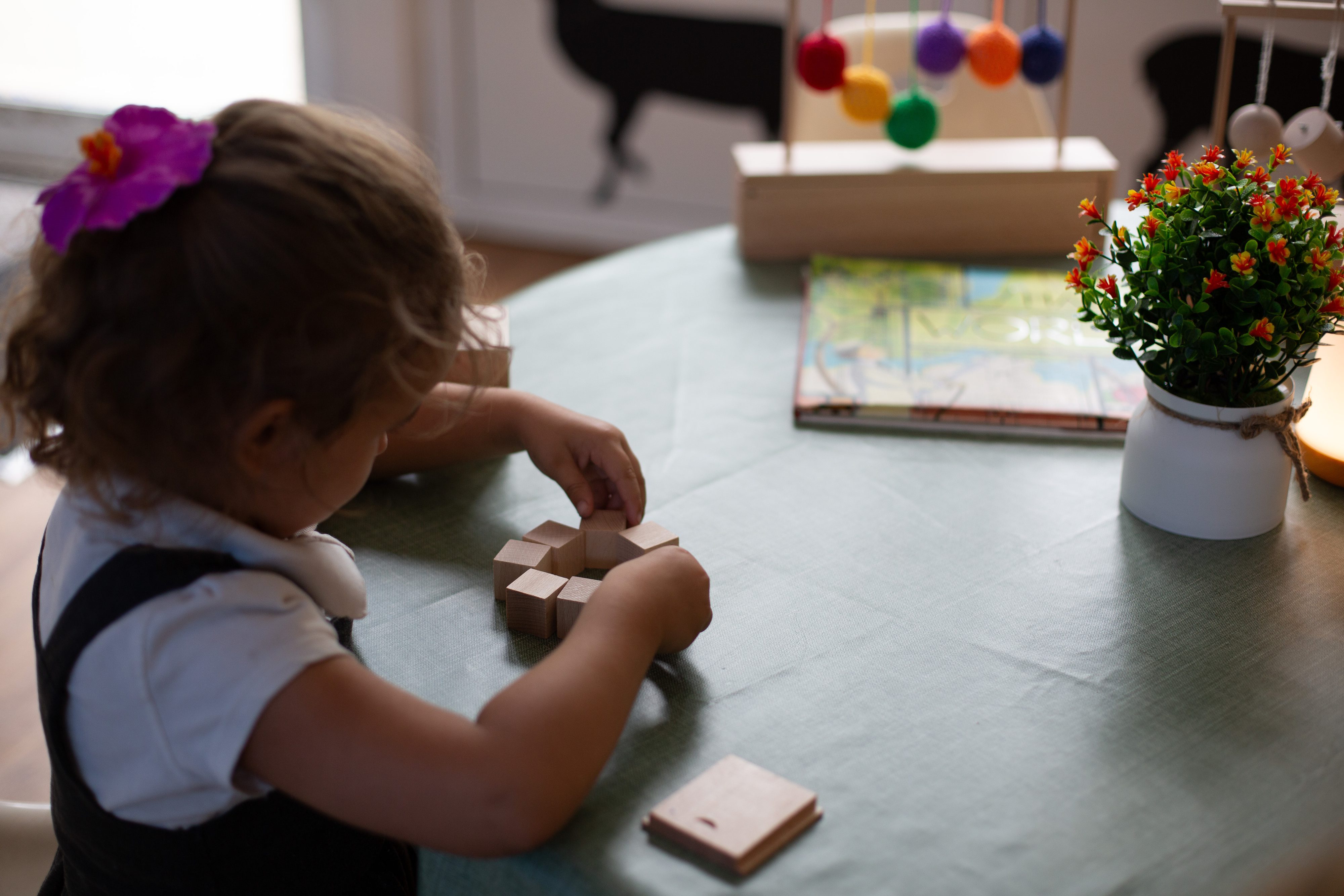
Within this process, pattern plays a central role. For example, in a pattern activity using the third Gift, when a child arranges forms in an alternating sequence - cube, diamond, cube, diamond - the activity is not decorative. It invites anticipation. The child begins to predict what will come next and to test that prediction through action. This embodied capacity for prediction forms the basis of higher-order thinking.
Human cognition is inherently predictive. We continuously simulate the world based on prior experience, seeking coherence and order. When patterns align with expectation, we experience a sense of stability. When they do not, uncertainty arises.
If children grow up in environments where information is abundant but sensory experience is limited, what will their understanding be anchored to?
In a world where artificial intelligence can process and deliver information more efficiently than any human, education must move beyond access to knowledge. It must cultivate the ability to perceive patterns, form meaningful connections, and interpret experience.
Hands-on engagement with form, structure, and pattern is not supplementary to intellectual development; it is foundational.
As we move further into the age of AI, we must ask not what machines can do better than humans, but what remains uniquely human. The ability to sense, to experience, to recognise patterns, and to construct meaning through embodied interaction cannot be replaced.
Education, therefore, must return to the hands - because we do not truly understand the world through information alone, but through experience and through what our hands have taught us to perceive.
Eunjeong Ahn
Founder of Saram in Gabe
Director of Aigongji Gabe Education Centre, Korea
Author of How Gabe Teaches Your Child's Brain: The Secret of Block Play for Thinking Skills in the Age of AI (Midasbooks, 2026)
About the author

Eunjeong Ahn is a Froebelian educator and author from South Korea with 24 years of experience teaching children from the early years through to upper-secondary level.
A student of the late Professor Seo Seok-nam, a pioneer of Froebel education in Korea, she has dedicated her work to preserving the original spirit and educational purpose of Froebel's philosophy.
Many of her students remain with her for six or seven years, and some who first came to her as young children are now university students working as actors, scientists, and aspiring graphic novelists. They continue to reflect openly on how Gabe education shaped their development and sense of self.
Through these long educational relationships, she has come to believe ever more deeply in the principle of self-activity - that each child carries an inner seed waiting to unfold, and that the teacher's role is to nurture its growth with patience and care.
Her book, 『가베가 알려주는 우리 아이 뇌 사용법』 (How the Gabe Teaches Our Children to Use Their Brain), published in January 2026, explores hand intelligence, brain development, and why sensory and experiential learning - the very essence of human intelligence has become even more essential in the age of AI.
She is the founder of Aigonji Gabe Institute (아이곤지 가베교육원) and director of the brand 사람 in 가베 (Saram in Gabe), through which she shares her educational practice and writing.
The Intelligence of the Hand - Review from Pete Moorhouse
Froebel Trust Travelling Tutor, Pete Moorhouse shares his review of the recently released book, How Gabe Teaches Your Child's Brain: The Secret of Block Play for Thinking Skills in the Age of AI written by Eunjeong Ahn.
Learn more


